WASHINGTON, DC – November 2-8, 2025, is National Vocation Awareness Week in the U.S. Catholic Church, an annual celebration dedicated to promoting vocations to the priesthood, diaconate, and consecrated life through prayer and education, and to renew prayers and support for those who are considering one of these particular vocations.
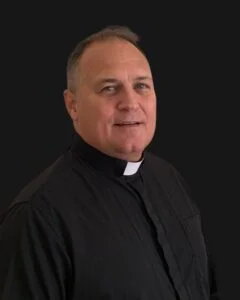
Any eligible young man sensing the call to serve as a Catholic U.S. Military chaplain is encouraged to speak with Father Paul-Anthony Halladay, CH (MAJ), USA (Ret.). The Vocation Director for the Archdiocese for the Military Services, USA (AMS)—to borrow the iconic phrase of Uncle Sam—“WANTS YOU”! The Military needs more Catholic priests to serve in all branches. “So my efforts in the Vocation Office are to encourage and accompany young men who may be interested in both military service and priesthood,” he says, “and to assist them on this path, according to God’s will.”
Father Paul-Anthony, 61, is not asking anyone to do anything he wouldn’t do; or hasn’t done. The retired U.S. Army chaplain and priest of the Archdiocese of Mobile, AL, served 20 years on active duty before Archbishop Timothy Broglio named him Director of Vocations on January 22. Father Paul-Anthony has personally ministered to soldiers everywhere from the U.S. Military Academy at West Point, to the front lines of combat in Iraq and Afghanistan. He has celebrated Mass for the troops, heard their confessions, anointed the wounded in battle, and provided pastoral care and spiritual leadership even in the worst of circumstances downrange.
“It was intense. It was very intense,” he says of his time on the ground at the Battle of Ramadi, a hard-fought, eight-month bloodbath for control of the capital of Anbar Province. Operation Iraqi Freedom ultimately prevailed in what is now considered a turning point in the war. Time Magazine at the time dubbed Ramadi Iraq’s “most dangerous place.” “I saw a lot of battles, a lot of gunfire, a lot of explosions,” says Father Paul-Anthony. “We lost a lot of men, and I had to console a lot of people.” His endurance at Ramadi showed him in real time why warriors need chaplains.
“Particularly when it comes to a firefight, if a soldier is killed, is shot, inevitably the questions that come up are ‘why him, why not me–we were right there next to one another. What happened?’ And trying to make sense out of why someone else died and not you, whenever you’re in the battle together, you’re in a circumstance together, is very difficult. It’s not an easy conversation to have with someone. And just trying to kind of put together in your own heart and head, ‘why is this happening, what is this really about, and where is God in all this?’ And that’s really, I think, the struggle for the chaplain–to kind of bring an understanding of how God’s love is still with us regardless of the hate and anger and animosity that we see in front of our eyes every day.”
War-torn Ramadi was quite the contrast from the quiet shady Avenue of the Oaks at Jesuit Spring Hill College in Mobile, AL, where a much younger Mr. Halladay studied business; or the lush West Indies, where he served for nearly three years in the Peace Corps before entering seminary; or the soft piney woods at Saint Joseph Seminary College in St. Benedict, LA, where he reflected on the philosophical writings of great thinkers; or the splendid Pontifical Gregorian University in Rome, where he immersed himself in the study of theology before he was ordained a priest in 2000.
Even so, Father Paul-Anthony’s genial background prepared him well for combat and the mission to “serve those who serve.” The Peace Corps, he says, was “an excellent introduction into the life of the priesthood, mainly because of the way in which they allow you to serve others.” In turn, the process of priestly formation was, its own way, sound training for active duty. “Seminary life is very regimented,” he says. “You get up at a certain time. You have certain responsibilities you have to do throughout the day. You have to be home at a certain time, and then there are responsibilities back at our house, so in that regard it was very much the same type of place, the same type of schedule as the Military.”
To encourage vocations, Father Paul-Anthony draws directly on one Army experience in particular. For three years he served as the Army’s Chaplain Recruiter, an assignment that exposed him to the challenges of his new role, which entails not only shepherding young men to chaplaincy but also finding a local bishop or religious superior willing to release a priest for military service. “Trying to find a diocese or a religious order that thinks they have enough priests to give the AMS a few was VERY difficult. There’s probably not a diocese out there in the U.S. or a religious order that believes they have enough priests for their own pastoral needs.”
In just a few months though, Father Paul-Anthony has harnessed his diverse experiences to achieve remarkable early success. In April he directed his first discernment retreat for prospective priests and chaplains. The AMS holds the event twice a year, and the spring retreat held April 3-6 this year at St. Patrick’s Seminary in Menlo Park, CA, drew 37 chaplain hopefuls—a record high—only to be surpassed by this year’s fall retreat, held Oct. 30-Nov. 2 at St. Mary’s Seminary in Baltimore, which drew 38 young men discerning priestly military service.
Father Paul-Anthony will direct the next discernment retreat at St. Partick’s Seminary in Menlo Park, CA, April 9-12, 2026. Young men interested in answering the “vocation within a vocation” to serve as a Catholic priest on active duty are invited to participate. For more information, contact Father Paul-Anthony at vocations@milarch.org or (202) 719-3600. Gifts in support of AMS Vocations are gratefully accepted at milarch.org/donate.